Emergency FoodGuide
How to Build a 3-Month Emergency Food Supply (Step-by-Step)
The Strait of Hormuz disruption and rising food prices make now the time to build your emergency food supply. This step-by-step guide shows you how to do it in 8–12 weeks.
By Editorial Team7 min read
Affiliate Disclosure: This article contains affiliate links. We may earn a commission if you purchase through these links, at no extra cost to you. Our editorial recommendations are independent of these partnerships. Learn about our editorial standards.
Key Takeaways
- 1A 3-month food supply for one person costs $450-1,500 depending on brand mix and calorie targets
- 2Build in phases: Week 1-4 buy staples (rice, beans), Week 5-8 add freeze-dried, Week 9-12 diversify and rotate
- 3ReadyWise 120 Serving Kit ($169) is the best starting point — great balance of variety and value
- 4Store food below 75°F in a cool, dry area for maximum 25-year shelf life on freeze-dried meals

Introduction
In late February 2026, US and Israeli strikes on Iranian nuclear facilities triggered a cascade of events that most American families never think about in connection with their grocery bills. Within days, tanker traffic through the Strait of Hormuz — which carries 21% of the world's oil — dropped by an estimated 70%. Fertilizer prices began climbing. Import timelines stretched. The direct line from geopolitical tension to your pantry shelf is shorter than most people realize.
That pressure arrives on top of an already stressed food supply chain. The USDA's Economic Research Service projected a 3% increase in food prices for 2026, driven by tariff-related packaging inflation and ongoing import delays. Building a 3-month emergency food supply sounds intimidating, but it doesn't require a warehouse or a large upfront investment. This step-by-step guide shows you exactly how to build one — starting with what you already have and layering up systematically over 8–12 weeks.
Key Takeaways
- A 3-month food supply for a family of four costs between $800–$1,500 total when built in stages — less than a tank of gas per week
- The USDA recommends 2,000 calories per adult per day; children and seniors need adjustments
- Start with 2 weeks of regular groceries, then add purpose-built emergency food kits for long-term coverage
- Freeze-dried and dehydrated foods last 25–30 years sealed — buy once and store indefinitely
- Rotate your stock: first-in, first-out (FIFO) keeps your supply fresh and reduces waste
Why a 3-Month Supply Makes Sense Right Now
The standard FEMA recommendation is 72 hours of food and water. That guidance made sense decades ago, when most emergencies were localized and short-lived. But the risk profile has shifted. Hurricane season power outages now average 12.8 hours nationally — but that's a median. In 2026's Winter Storm Fern, 750,000 customers lost power for multiple days. Supply chain bottlenecks in 2020–2021 left grocery shelves empty for weeks.
Three months of food storage — roughly 90 days — covers you for the realistic worst case: a prolonged regional disruption, a personal financial crisis, or an extended period when shopping isn't practical. It also provides a built-in hedge against food price inflation. If staples cost 3% more next year, the food you store today is the food you bought at today's prices.
What Counts as a '3-Month Supply'?
For planning purposes, a 3-month supply means food that provides your entire household's caloric needs for 90 consecutive days — without relying on grocery stores, restaurants, or food delivery. It should cover breakfast, lunch, dinner, and snacks, and include enough variety to prevent "food fatigue."
Step 1: Calculate Your Household's Actual Needs
Before you buy a single can, know what you're building toward. The math is straightforward.
Daily Calorie Requirements
The USDA recommends the following daily calorie baselines for emergency planning:
- Adults (active): 2,000–2,500 calories/day
- Adults (sedentary): 1,600–2,000 calories/day
- Children ages 4–8: 1,200–1,400 calories/day
- Children ages 9–13: 1,400–1,800 calories/day
- Teens: 1,800–2,200 calories/day
- Seniors: 1,600–2,000 calories/day
For a family of four (two adults, two school-age children), a reasonable planning figure is approximately 7,000–8,000 calories per day total. Over 90 days, that's 630,000–720,000 calories.
Don't Forget Water
Food storage planning always goes alongside water storage. The standard recommendation is one gallon of water per person per day for drinking and sanitation. A family of four needs 360 gallons for 90 days — which is why most families combine stored water (2–4 weeks) with a quality water filtration system for longer-term needs.
Step 2: Build Your Foundation — The 2-Week Pantry Layer
The easiest and cheapest first step is to build a 2-week supply from foods you already eat. This approach requires no special storage equipment and costs nothing extra if you shop your normal sales.
The pantry-first method: Over 4–6 grocery trips, buy two of everything instead of one. Canned goods, rice, pasta, oats, nut butter, honey, dried beans. Focus on items with at least a 1–2 year shelf life that your family already enjoys. Two weeks of pantry food for a family of four typically costs $150–$300.
Pro Tip: The 'Deep Pantry' Approach
Rather than buying a separate "emergency food supply," some families prefer to simply deepen their existing pantry. Keep 2–3 of every staple you use regularly, rotate on a first-in, first-out basis, and replenish as you consume. This method has zero waste, zero food fatigue, and costs nothing extra per shopping trip.
Step 3: Add 30 Days with Purpose-Built Emergency Food Kits
Once you have 2 weeks of pantry coverage, layer in a purpose-built kit for the next 30 days. These kits use freeze-dried or dehydrated food with 25-year shelf lives, which means you're not racing a clock on expiration dates.
The Augason Farms 30-Day Emergency Pail is one of the most accessible entry points. It contains roughly 36,000 calories across a variety of breakfast and dinner options — enough to provide one adult with 1,200 calories per day for 30 days, or to supplement your pantry layer for a family of four for about 7–10 days.
For families who want a complete, pre-portioned solution for the first month, the My Patriot Supply 4-Week Kit provides 2,000 calories per day for one adult for 28 days — designed to be a standalone 4-week food supply for one person. For a family of four, you'd need four of these kits to cover a full month.
Step 4: Scale Up to 3 Months with Higher-Capacity Kits
Once you have month one covered, the jump to three months is straightforward: add higher-capacity kits for months two and three.
Emergency Food Kits — Comparison
| Feature | ||||
|---|---|---|---|---|
| Price | ~$249 | ~$169 | ~$197 | ~$89 |
| Calories | ~19,200 | ~16,200 | ~56,000 | ~36,000 |
| Shelf Life | 25 years | 30 years | 25 years | 25 years |
| Servings | 120 | 72 | ~280 | ~307 |
| Best For | Value-focused families starting out | Best flavor ratings | Most complete single-person 4-week solution | Best budget entry point |
ReadyWise 120 Serving Kit
~$249
- Calories
- ~19,200
- Shelf Life
- 25 years
- Servings
- 120
- Best For
- Value-focused families starting out
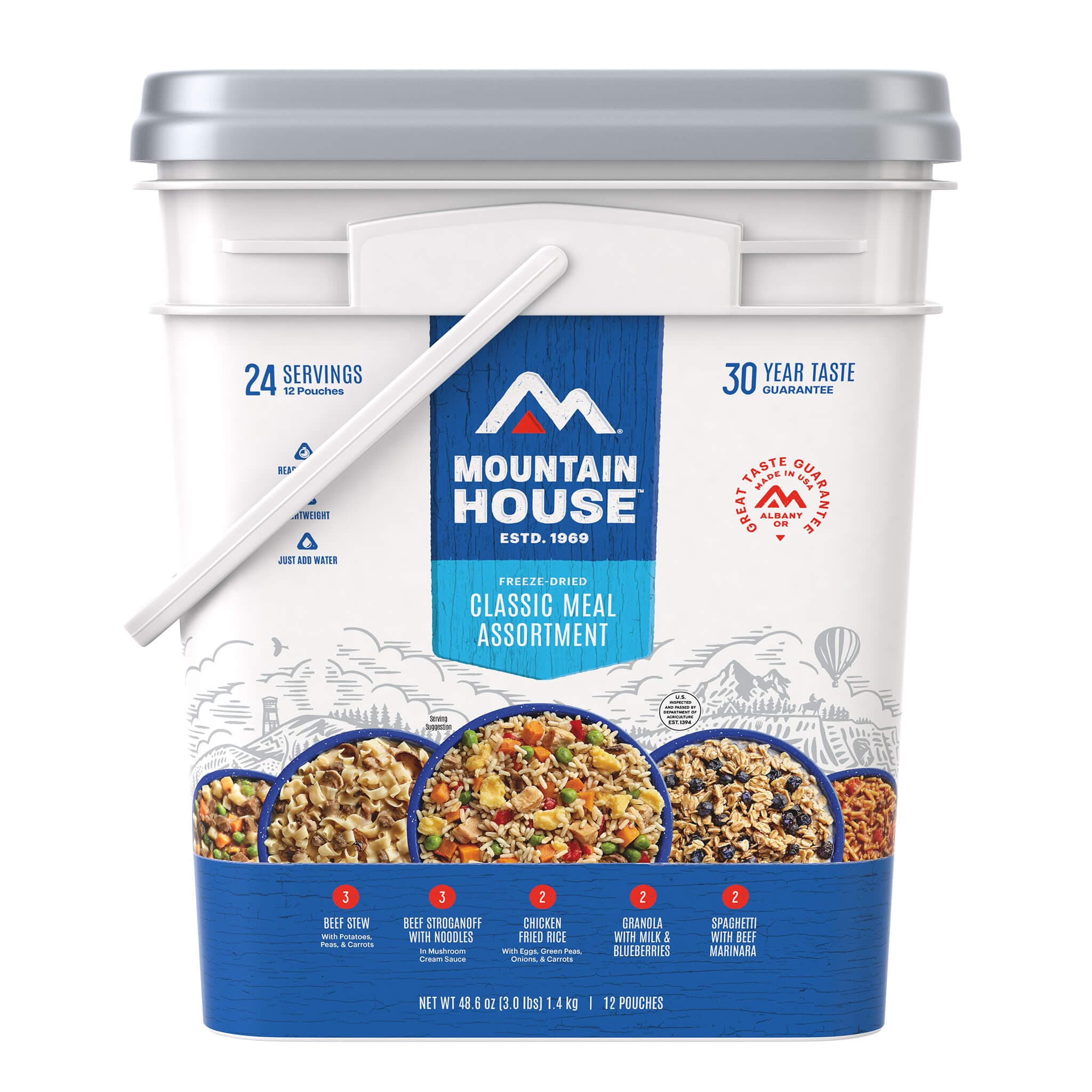
Mountain House Classic Bucket
~$169
- Calories
- ~16,200
- Shelf Life
- 30 years
- Servings
- 72
- Best For
- Best flavor ratings
My Patriot Supply 4-Week Kit
~$197
- Calories
- ~56,000
- Shelf Life
- 25 years
- Servings
- ~280
- Best For
- Most complete single-person 4-week solution
Augason Farms 30-Day Emergency Pail
~$89
- Calories
- ~36,000
- Shelf Life
- 25 years
- Servings
- ~307
- Best For
- Best budget entry point
ReadyWise 120 Serving Emergency Food Kit
The ReadyWise 120 Serving Kit is our top recommendation for families building their first serious emergency food supply. It covers breakfast and entrée options across 120 servings — enough to meaningfully supplement a family of four's food supply for 2–3 weeks. ReadyWise uses individually packaged pouches inside a weather-resistant bucket. Each pouch requires only boiling water and 12–15 minutes of rehydration.
ReadyWise 120 Serving Kit
Pros
- Competitive price per serving (~$2.07/serving), making it accessible for most families
- 25-year shelf life means you buy it once and forget about it
- Wide variety of breakfast and entrée options reduces food fatigue risk
- Easy preparation — just add boiling water
Cons
- Serving sizes tend toward smaller portions; active adults may need supplementation
- Some entrées are higher in sodium, which matters for anyone watching salt intake
- Not fully vegetarian — contains chicken in several meals
Mountain House Classic Bucket
If taste is your top priority, the Mountain House Classic Bucket consistently outperforms competitors in blind taste tests. Mountain House has been supplying freeze-dried food to hikers and military units since 1969, and the quality shows. The Classic Bucket contains 72 servings with a 30-year shelf life — the longest of any mainstream emergency food brand.
Mountain House Classic Bucket
Pros
- Best-in-class taste — consistently top-rated in consumer reviews
- 30-year shelf life (longest available in mainstream emergency food)
- Trusted brand with 55+ years of freeze-drying expertise
- Individual pouches reseal easily for portioning
Cons
- Higher cost per serving (~$2.35) than budget alternatives
- Fewer breakfast options — bucket is primarily dinner-focused
- 72 servings covers one adult for roughly 36 days at 2 meals/day
Step 5: Storage, Rotation, and Organization
Buying emergency food is only half the equation. Storing it correctly determines how long it actually lasts.
Ideal Storage Conditions
Freeze-dried and dehydrated food lasts longest when stored at consistent, cool temperatures. The manufacturers' stated shelf lives (25–30 years) assume storage at 55–70°F. For every 10°F increase above 70°F, you meaningfully reduce that shelf life.
- Best: A basement or interior closet with no direct sunlight and stable temperatures
- Acceptable: An interior bedroom closet on the ground floor
- Avoid: Garage storage in most climates (temperature swings), attics, or anywhere that gets above 80°F regularly
FIFO Rotation: First In, First Out
For pantry foods (canned goods, rice, pasta), use the FIFO method: when you buy new stock, put it behind older stock on the shelf. Eat from the front. Replenish from the back. For freeze-dried kits with 25+ year shelf lives, active rotation isn't necessary — but sample a kit every few years to verify quality.
Label Everything with Purchase Dates
Write the purchase date on every case of canned goods or emergency food kit with a permanent marker. Many products list a "best by" date but not a purchase date, which makes rotation harder to track. Spending 30 seconds labeling each item when you store it saves significant guesswork later.
Common Mistakes When Building a Food Supply
Ignoring food allergies and dietary restrictions. If someone in your household has celiac disease, a nut allergy, or a religious dietary requirement, verify ingredient lists carefully before buying in bulk.
Buying only what's cheapest. The lowest cost-per-serving option isn't always the best value if nobody in your family will eat it. Food fatigue is a documented phenomenon — people under stress eat less when meals are repetitive or unappetizing.
Forgetting cooking fuel and equipment. Freeze-dried food requires boiling water. If your power is out, you need a camp stove, fuel canisters, or another heat source.
Underestimating water needs. Most rehydratable emergency foods require 1–2 cups of water per serving. For a family of four eating two freeze-dried meals per day, that's 8–16 cups of water just for food preparation — on top of drinking and sanitation needs.
Building it all at once. A 3-month supply bought in a single order costs $500–$1,500+ upfront. The staged approach — 2 weeks → 1 month → 3 months, built over 8–12 weeks — is more practical for most families.
How Much Does a 3-Month Supply Actually Cost?
- 2-week pantry layer: $150–$300 (regular grocery trips)
- Month 1 (pre-built kits): $200–$400 (2x Augason Farms pails or equivalent)
- Months 2–3 (higher-capacity kits): $400–$800 (ReadyWise or Mountain House at scale)
- Total estimated cost: $750–$1,500 — less than $15–$18 per week built over 3 months
Frequently Asked Questions
How many calories per day should I plan for in an emergency food supply?
The USDA recommends planning for 2,000 calories per adult per day as a baseline. Active adults or those doing physical labor during an emergency may need 2,500 or more. Children need 1,200–1,800 calories depending on age. When purchasing kits, read the stated calorie counts carefully — some brands market serving counts that translate to only 1,200–1,400 calories per day.
What's the difference between freeze-dried and dehydrated emergency food?
Freeze-drying removes about 98% of moisture by freezing food and then reducing pressure to allow ice to vaporize directly. Dehydration uses heat to evaporate moisture, typically removing 80–90%. Freeze-dried food has a longer shelf life (25–30 years vs. 5–15 years), retains more nutritional value, and rehydrates more quickly. It also costs more.
Can I build a 3-month supply without buying pre-made kits?
Yes. Many families build their supply entirely from bulk dry goods: 50-pound bags of white rice, dried beans, oats, pasta, and supplementary canned goods. This is the most economical approach — potentially $300–$500 total for a family of four — but it requires more planning, proper Mylar bag and oxygen absorber storage, and deliberate variety management.
How long does emergency food supply last once opened?
Freeze-dried food in individual pouches typically lasts 5–7 days once opened, and should be kept in a sealed container. Large #10 cans of dehydrated food last 1–2 weeks after opening in a cool, dry environment.
Do I need to rotate freeze-dried emergency food?
Freeze-dried food with 25–30 year shelf lives doesn't require active rotation the way canned goods do. However, it's worth doing a "taste test" every 5 years or so to verify quality. Canned goods should be rotated on a 2–3 year cycle using the FIFO method.
Is it worth buying organic or non-GMO emergency food?
Several brands offer non-GMO certified options at a premium. From a pure emergency preparedness standpoint, the most important factors are caloric density, shelf life, taste, and cost — certifications are secondary. If organic or non-GMO matters to your household for everyday food choices, it likely matters here too.
Frequently Asked Questions
Bottom Line
Building a 3-month emergency food supply is a practical, affordable project that most families can complete in 8–12 weeks without major disruption to the grocery budget. The Strait of Hormuz disruption and ongoing food price inflation are reminders that food supply chains aren't as resilient as we assume.
Start with two weeks of the foods your family already eats. Add one month of purpose-built freeze-dried kits. Then scale to three months as budget allows. The ReadyWise 120 Serving Kit offers the best combination of value, variety, and reliability for most families making their first serious investment in food storage.
build emergency food supply3 month food supplyemergency food storagelong term food storagefood inflation preparednessemergency food kits 2026
Where to Buy
We may earn a commission when you purchase through these links, at no extra cost to you. This supports our independent research.
Related Articles
Emergency Food
Guide
Growing Your Own Emergency Food Garden: A Beginner's Guide
Learn how to grow an emergency food garden as a beginner — best crops, planting calendar, seed saving, and how to store what you grow for year-round food security.
Read more →

Emergency Food
Checklist
Emergency Food Storage Checklist: 30, 90, and 365-Day Supplies
A practical emergency food storage checklist for 30, 90, and 365-day supplies — with shopping lists, shelf life data, and ready-made kit options for every budget.
Read more →
Emergency Food
Comparison
Best Freeze-Dried Food for Long-Term Storage (2026 Review)
Our honest comparison of 5 top freeze-dried food kits for 2026 — real calorie counts, price per serving, and who each kit is actually right for.
Read more →