GuidesPillar
Hurricane Prep 2026: How to Get Ready Before the Season Starts
Get your home and family ready for the 2026 Atlantic hurricane season with this complete guide: emergency kit, power backup, home hardening, evacuation plan, and insurance checklist.
By Editorial Team7 min read
Affiliate Disclosure: This article contains affiliate links. We may earn a commission if you purchase through these links, at no extra cost to you. Our editorial recommendations are independent of these partnerships. Learn about our editorial standards.
Key Takeaways
- 1Hurricane season runs June 1 - November 30 — complete all preparations before May 31 while supplies are available
- 2EcoFlow Delta Pro Ultra is our top pick for hurricane backup power — 6,144Wh base keeps a house running for days
- 3Store 7-14 days of water (1 gallon/person/day) and fill bathtubs when a hurricane watch is issued
- 4Know your evacuation zone and routes — leave early when ordered; highways become parking lots within hours
Introduction
Atlantic hurricane season officially runs from June 1 through November 30, but preparation should begin months earlier — ideally by March or April, before supplies get picked over and contractors' schedules fill up.
In 2026, the case for early preparation is stronger than usual. Climate scientists and NOAA seasonal forecasters are monitoring elevated sea surface temperatures in the Atlantic basin and La Niña conditions that reduce upper-level wind shear — both factors historically associated with above-average hurricane seasons.
There's also a new financial consideration this year. Fuel costs have spiked following geopolitical disruptions in the Strait of Hormuz in late February 2026, with Brent crude rising approximately 13% to around $82 per barrel. Higher fuel prices make generator operation more expensive and last-minute evacuation more costly.
This guide covers everything a family needs to get ready: emergency kit essentials, home hardening, evacuation planning, communication equipment, and the financial and insurance steps most people skip until it's too late.
Key Takeaways
- The 2026 Atlantic hurricane season runs June 1 – November 30; preparation should be complete by May
- Start with FEMA's core kit framework: water (1 gallon/person/day for 3+ days), food, power, communications
- Know your evacuation zone before a storm is named — zone maps are available from your county emergency management office
- Home hardening investments (roof straps, impact windows, garage door bracing) offer the highest return-on-investment
- Review homeowner's insurance and flood insurance coverage in March or April — policies take 30 days to take effect
The 2026 Atlantic Hurricane Season Outlook
NOAA releases its official outlook for the Atlantic hurricane season each May, with an update in August. Warm Atlantic sea surface temperatures — which act as fuel for tropical systems — have been persistently above average. La Niña conditions, which reduce the upper-level wind shear that tends to tear apart developing storms, were active entering 2026.
An average Atlantic hurricane season produces approximately 14 named storms, 7 of which reach hurricane strength (sustained winds of 74 mph or above), and 3 that intensify to major hurricane status (Category 3 or higher, winds of 111 mph+), according to NOAA records.
Hurricane Categories: What They Mean Practically
- Category 1 (74–95 mph): Dangerous winds; some roof and siding damage; power outages expected
- Category 2 (96–110 mph): Extremely dangerous; major roof damage; extended power outages (days to weeks)
- Category 3 (111–129 mph): Devastating damage; structural damage likely; power/water out for days to weeks
- Category 4 (130–156 mph): Catastrophic damage; most well-built homes lose roof structure; power out for weeks to months
- Category 5 (157+ mph): Complete destruction of most buildings; areas uninhabitable for weeks to months
Building Your Hurricane Emergency Kit
FEMA's emergency kit framework provides a reliable starting point. A well-stocked hurricane kit ensures your household can be self-sufficient for at least 72 hours after a major storm.
Water: Your First Priority
Water is non-negotiable. FEMA recommends one gallon per person per day for drinking and basic sanitation. For a family of four over three days, that's a minimum of 12 gallons. A countertop gravity water filter like the Big Berkey Water Filter provides a critical backup that can purify water from virtually any fresh source.
Emergency Food Supply
For a three- to seven-day hurricane kit, the goal is shelf-stable food that requires minimal preparation. The ReadyWise 72-Hour Kit is designed specifically for this purpose — covering meals for one adult for 72 hours with freeze-dried entrees that have a 25-year shelf life.
Emergency Power: The Most Important Investment
Power outages are the defining feature of most hurricane impacts. After Hurricane Helene in 2024, hundreds of thousands of customers in the Carolinas and Georgia went without power for one to two weeks. FEMA considers seven to ten days of power self-sufficiency a realistic planning target.
Hurricane Power Backup Systems Compared
| Feature | ||
|---|---|---|
| Price | Check price | Check price |
| Capacity | 6,144Wh (expandable to 21.6kWh) | 2,048Wh (expandable to 8,192Wh) |
| AC Output | 7,200W | 2,200W |
| Solar Input | Up to 5,600W | Up to 900W |
| Best For | Whole-home critical circuit backup; families | Most households; best value at this capacity |
EcoFlow Delta Pro Ultra
Check price
- Capacity
- 6,144Wh (expandable to 21.6kWh)
- AC Output
- 7,200W
- Solar Input
- Up to 5,600W
- Best For
- Whole-home critical circuit backup; families
Bluetti AC200MAX
Check price
- Capacity
- 2,048Wh (expandable to 8,192Wh)
- AC Output
- 2,200W
- Solar Input
- Up to 900W
- Best For
- Most households; best value at this capacity
EcoFlow Delta Pro Ultra
The EcoFlow Delta Pro Ultra is the most capable home backup power system currently available for residential use. Its base capacity of 6,144Wh can expand to 21.6kWh by adding battery modules, and its 7,200W AC output is sufficient to run central air conditioning, a full-size refrigerator, and multiple large appliances simultaneously.
EcoFlow Delta Pro Ultra
Pros
- 6,144Wh base capacity, expandable to 21.6kWh with battery modules
- 7,200W AC output supports whole-home critical circuits including HVAC
- Smart Home Panel 2 integration allows direct wiring to breaker panel
- Solar charging up to 5,600W enables genuine off-grid capability
Cons
- Premium price point; highest cost in our comparison
- Base unit weighs approximately 124 lbs — requires permanent placement
- Full whole-home capability requires purchase of Smart Home Panel 2 as an add-on
Bluetti AC200MAX
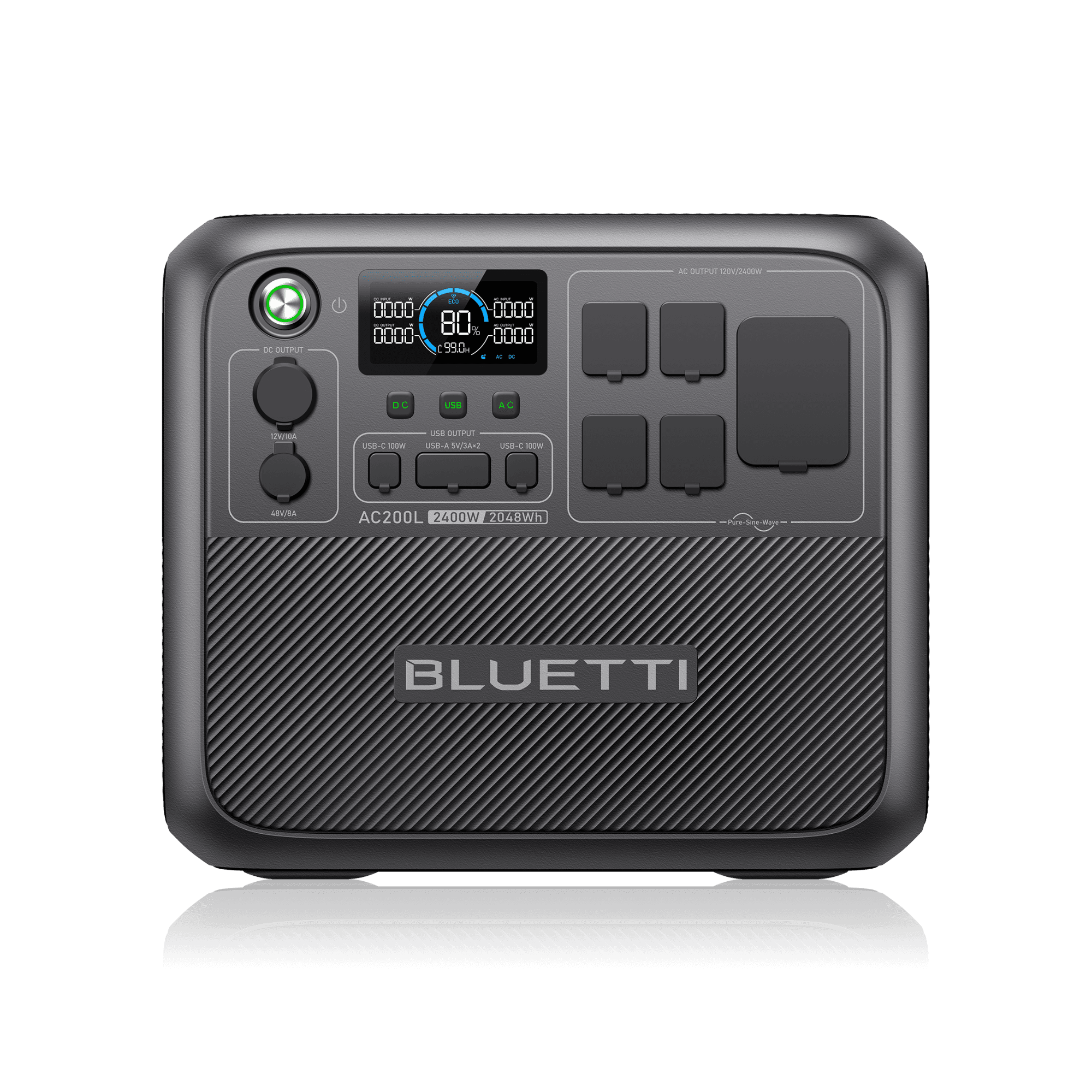
The Bluetti AC200MAX is our recommendation for most households. Its 2,048Wh capacity can run a full-size refrigerator for approximately 8–10 hours, keep essential lights and devices charged for several days, and power a CPAP machine or medical equipment.
Bluetti AC200MAX
Pros
- 2,048Wh capacity covers essential household loads for 1–3 days
- Expandable to 8,192Wh by adding B300 battery modules
- 900W solar input enables off-grid recharging during extended outages
- 2,200W AC output handles most household appliances individually
Cons
- Not designed for whole-home HVAC on its own; central AC requires larger units
- Expansion modules (B300) are a separate purchase
- 61 lbs makes it portable but not lightweight
Home Hardening: Protecting the Structure Itself
Every dollar spent on home hardening before a hurricane works harder than emergency supplies purchased after a storm. A roof that stays intact means no water intrusion, no mold, and no displacement.
Roof, Windows, and Exterior Doors
Your roof is your home's first line of defense against hurricane-force winds. A licensed roofing or structural contractor can assess your current roof attachment and install hurricane straps where they're missing. This is typically one of the most cost-effective structural improvements available and may qualify for an insurance discount.
For windows, impact-resistant glass is the gold standard — it eliminates the need for shutters during a storm. If replacement windows aren't in the budget, storm shutters (panel, accordion, or roll-down) provide strong protection.
Florida's My Safe Florida Home Program
Florida residents may qualify for free home inspections and matching grants for home hardening improvements including impact windows, storm shutters, and roof reinforcement through the My Safe Florida Home program. Similar programs exist in other Gulf Coast states. Completing these improvements before June 1 ensures your home is protected and may reduce your insurance premium.
Garage Doors
Garage doors are frequently the first structural failure point in a hurricane. When a garage door fails, wind enters the structure and can blow off the roof from the inside — a catastrophic cascade. Brace kits cost $100–$300; for Category 3+ zones, replacing the door with a wind-rated model is more reliable.
Flood Protection
Storm surge is the leading cause of hurricane-related fatalities in the US, according to NOAA. Know your property's flood zone designation (available from FEMA's flood map service at msc.fema.gov). Flood barriers and door dams ($100–$500) can prevent minor surface flooding but are not effective against significant storm surge.
Creating Your Hurricane Evacuation Plan
Many people wait for a mandatory evacuation order before deciding whether to leave. By that point, fuel is scarce, roads are gridlocked, and hotels within range are sold out.
Know Your Evacuation Zone
Every coastal county in a hurricane-risk state has published evacuation zones — typically lettered A through E, with Zone A representing the highest risk. Zone A residents should have a non-negotiable evacuation plan for any Category 2+ storm.
Go-Bag Essentials
A go-bag is a pre-packed bag you can grab and leave with in 10–15 minutes. Essential contents:
- Government-issued ID, passports, and insurance documents (originals or copies in a waterproof bag)
- Three days of cash (ATMs fail during and after major storms)
- Medications (minimum 7-day supply) and medical devices
- Phone chargers and a portable battery pack
- Change of clothing and rain gear
- Basic first aid kit
- Water and snacks for the evacuation drive
- Pet supplies if applicable
Evacuation Routes
Identify at least two evacuation routes from your home in different directions. Book hotels as early as possible once a storm is being tracked — don't wait for a mandatory evacuation order. Make accommodations for pets now, as most public emergency shelters don't accept animals.
Timing Your Departure
FEMA consistently notes that the biggest barrier to successful evacuation is delayed decision-making. If a Category 3+ storm is forecast within 72 hours of your area, treat an evacuation as the default action — not a last resort. The cost of an unnecessary evacuation is far smaller than the cost of sheltering in place during a major storm.
Staying Informed: Communication During a Hurricane
The Midland ER310 Emergency Radio is our recommended communications device for hurricane preparedness. It receives all NOAA Weather Radio all-hazards channels, AM/FM, and is specifically certified to receive Emergency Alert System broadcasts for your county. It charges via solar panel, hand crank, or AC power — and can also charge your phone via USB.
Midland ER310 Emergency Radio
Pros
- NOAA Weather Radio all-hazards certified with alert alarm function
- SAME technology enables county-level emergency alerts
- Multiple charging options: hand crank, solar, AC, or USB-C
- Can charge smartphones via USB output; compact and lightweight for go-bags
Cons
- AM/FM reception can be limited in some locations compared to dedicated home radios
- Hand-crank charging is slow (about 1 minute of cranking per few minutes of play)
Financial and Insurance Preparation
This is the section most people skip — until they're sitting in a damaged home arguing with their insurance company.
Review Your Homeowner's Insurance Policy
Pull your homeowner's insurance policy now. Check: your wind/hurricane deductible (often 1–5% of insured value in coastal states), whether roof replacement is covered at actual cash value (ACV) or replacement cost value (RCV), and whether temporary living expenses are covered.
Contact your insurer in March — not June. Hurricane coverage can take 30 days to go into effect, and most insurers institute a binding moratorium when a named storm is being tracked.
Purchase Flood Insurance Through NFIP
Standard homeowner's insurance policies do not cover flood damage — including storm surge. NFIP flood insurance policies take 30 days to take effect. In high-risk flood zones, a mortgage lender will likely require it. In moderate-risk zones, a significant percentage of NFIP claims come from these areas.
Create a Home Inventory
After a major storm, a detailed home inventory is worth thousands of dollars in accurate insurance claims. Photograph or video every room of your home, documenting major appliances, electronics, furniture, and valuables. Store in cloud storage or keep a physical copy in your go-bag.
After the Storm: Recovery Basics
Before re-entering your home after a hurricane, confirm with local authorities that it's safe. Document all damage photographically before cleaning up or making temporary repairs — this is critical for your insurance claim. For temporary repairs, keep all receipts.
Common Hurricane Prep Mistakes
- Waiting until a storm is named — handle all logistics in April or May
- Relying on a gas generator without adequate fuel storage — solar-capable battery systems avoid fuel dependency
- Assuming cell service will work — cell towers become overloaded during storms; a dedicated weather radio is essential
- Skipping the go-bag — pack go-bags in May and update them before June 1
- Not planning for pets — most public shelters do not accept pets; identify pet-friendly options early
Frequently Asked Questions
When should I start preparing for hurricane season 2026?
Now — March through April is the ideal preparation window. Supply availability, contractor scheduling, and insurance policy waiting periods all favor early action.
How much water should I store for a hurricane?
FEMA recommends one gallon per person per day. For a family of four planning for seven days, that's 28 gallons minimum. Supplement with a gravity water filter for larger-volume needs.
Is a battery-powered station worth it over a gas generator for hurricanes?
For most households in 2026, yes — particularly given current fuel price volatility. Solar-capable battery stations can be recharged from sunlight during extended grid outages, eliminating fuel dependency. Gas generators are louder, require outdoor operation (carbon monoxide risk), and depend on fuel supply chains that can fail after major storms.
Do I need a separate flood insurance policy?
If you're in a FEMA high-risk flood zone (Zone A, AE, or VE), almost certainly yes. Standard homeowner's insurance does not cover flood damage, including storm surge. Flood insurance through NFIP takes 30 days to take effect, so purchase before June.
How do I find my evacuation zone?
Search "[your county name] evacuation zones" or visit your county's emergency management office website. Your zone (typically A–E) determines when you should evacuate based on storm track and intensity.
Frequently Asked Questions
Bottom Line
Hurricane preparedness in 2026 comes with new variables — an active season forecast, higher fuel costs from geopolitical disruptions, and fresh reminders from 2024's major storms. The fundamentals haven't changed: start with water, food, and a power backup that matches your household's needs.
The Bluetti AC200MAX is our recommendation for most households balancing capability and cost. For families in high-risk zones, the EcoFlow Delta Pro Ultra's whole-home capability is worth the premium investment.
hurricane preparedness 2026hurricane prephurricane seasonhurricane kithurricane evacuation planhome hardening hurricaneemergency power hurricanehurricane 2026
Where to Buy
We may earn a commission when you purchase through these links, at no extra cost to you. This supports our independent research.
Related Articles

Guides
Checklist
The Complete Emergency Preparedness Checklist for 2026 (Updated)
The complete emergency preparedness checklist for 2026 — water, food, power, communications, first aid, documents, shelter, and evacuation. Updated for current events and products.
Read more →
Guides
Comparison
Best Air Purifiers for Wildfire Smoke and Emergency Air Quality (2026)
Find the best air purifier for wildfire smoke in 2026. We compare True HEPA models by CADR, room coverage, and activated carbon filtration — plus how to run them during power outages.
Read more →

Guides
Guide
Home Cybersecurity for Preppers: Protecting Your Smart Home During Grid Events
Volt Typhoon and grid fragility make smart home preparedness more important than ever. Learn what happens to your connected devices during outages and how to protect them.
Read more →
Solar Generators
Comparison
Solar Generator vs Gas Generator: Which Is Better for Hurricane Season 2026?
Compare solar generators and gas generators for hurricane season 2026 — upfront costs, runtime, safety, and total cost of ownership with our top three solar picks.
Read more →